

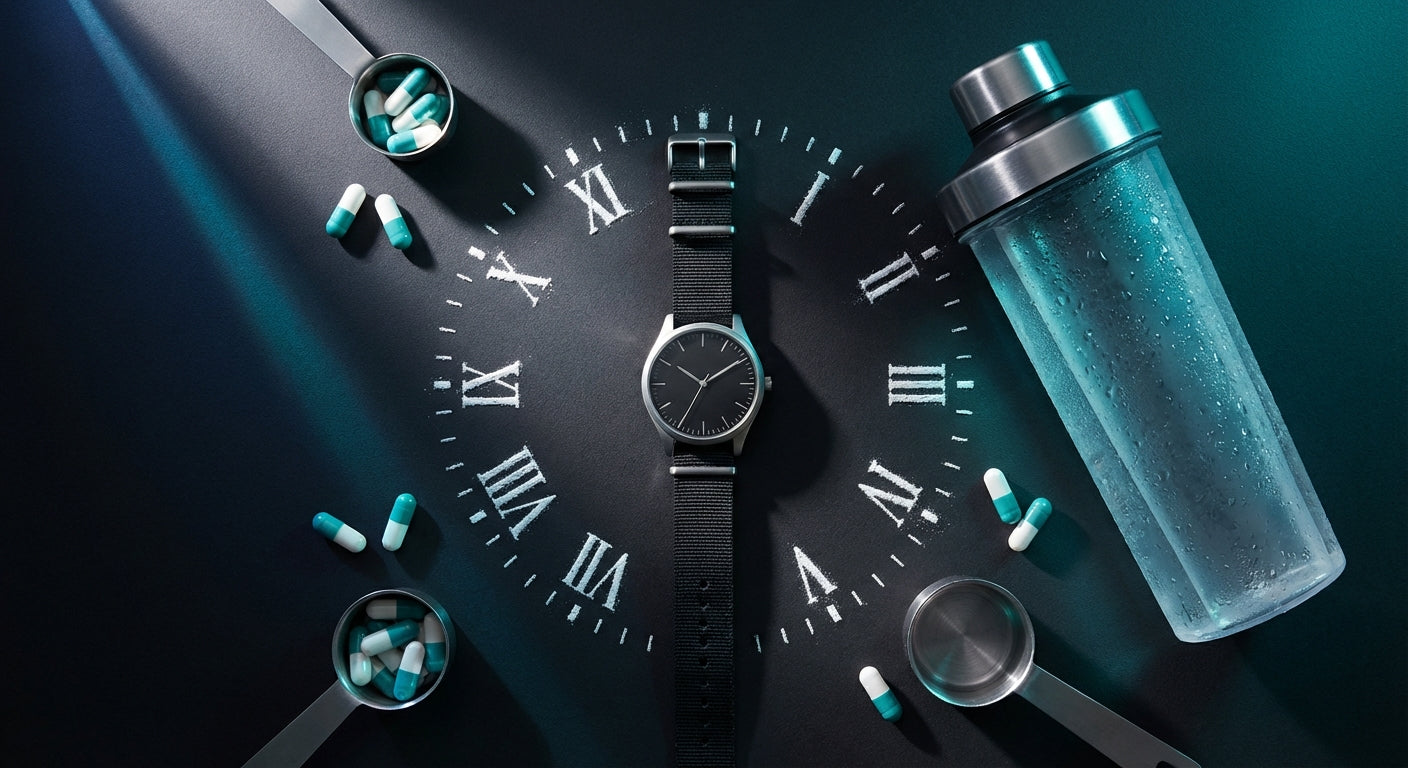
Stop Guessing When to Take Your Supplements
Here's the truth: most athletes nail what they take but completely ignore when they take it. That gap between good results and great results? It's called supplement timing.
Let's kill an old myth right now. The idea that you have a tiny 30-minute "anabolic window" to slam a protein shake or lose all your gains is outdated. Research cited by GymNation, referencing the Journal of the International Society of Sports Nutrition, shows that window stretches 4 to 6 hours around your workout. Breathe easy.
But that doesn't mean timing is irrelevant. Strategic timing is the hidden performance multiplier that separates athletes who plateau from athletes who keep climbing. In this guide, we break down the three primary windows (pre, intra, and post-workout) plus the often-ignored fourth window most competitors are sleeping on. Literally. Bold claims, real science, zero fluff. Let's go.
The Pre-Workout Window (30 to 60 Minutes Before Training)
This is where your session is won or lost before you even touch a barbell. The pre-workout window is all about priming your body for peak output, and caffeine is the most time-sensitive ingredient in the equation.
According to research published on PMC, caffeine peaks in your bloodstream within 30 to 60 minutes of ingestion. The optimal dose is 3 to 6 mg per kilogram of body weight. That means a 180-pound athlete should aim for roughly 245 to 490 mg, consumed 30 to 60 minutes before training to align with peak alertness and fatigue reduction. Approximately 90% of adults and up to 70% of competitive athletes already use caffeine regularly. The question isn't whether you use it; it's whether you're timing it right.
Caffeine isn't the only player. L-Citrulline and L-Arginine should also be consumed pre-workout to maximize nitric oxide production and drive blood flow to working muscles, according to the iHerb Wellness Hub. More blood flow means better nutrient delivery, better pumps, and better performance.
Now, creatine timing. A PMC review on creatine timing confirms that peri-workout dosing (before or after training) is superior to taking creatine far from your session. Even better: co-ingesting creatine with carbohydrates boosts muscle creatine uptake by approximately 60% thanks to the insulin response, as documented in a separate PMC study. Pair your creatine with fast carbs and watch absorption skyrocket.
Training in the evening or sensitive to stimulants? Stimulant-free pre-workout options are surging in popularity, and the timing principles still apply. L-Citrulline, beta-alanine, and creatine don't need caffeine to do their jobs. Keep that 30 to 60 minute pre-session window locked in.
Fasted training flag: If you train on an empty stomach, the pre-workout window becomes even more critical. Consider adding EAAs (essential amino acids) before your session to create a protective buffer against muscle breakdown. Your body needs fuel; give it the building blocks it requires.
The Intra-Workout Window (During Training)
Not every session demands an intra-workout supplement. According to Kaged, intra-workout supplementation is most beneficial for sessions lasting 60 to 90 minutes or more. If your workout clocks in under 45 minutes, you can likely skip a separate intra product.
For those longer, grind-it-out sessions, intra-workout nutrition is a game-changer. The debate between BCAAs and EAAs has a clear winner. As noted by Bulk Nutrients, EAAs provide the full spectrum of essential amino acids, making them superior for reducing muscle breakdown and fueling endurance during extended training. BCAAs are good; EAAs are better.
Don't overlook electrolytes. Sodium, potassium, and magnesium get depleted fast through sweat. Lose too much and you're looking at cramping, reduced muscle contraction quality, and a session that falls apart in the final sets. Replenish them throughout your workout.
Pro tip: Sip on an EAA plus electrolyte blend throughout your session rather than chugging it all at once. Steady delivery beats a single flood every time.
Here's a nuanced move most guides skip: if you're using beta-alanine, try staggering your doses across pre-workout and intra-workout. This reduces paresthesia (that intense tingling sensation) while still maximizing carnosine saturation over time.
Fasted athletes, listen up: Intra-workout EAAs become non-negotiable when training in a fasted state. Without pre-existing fuel from a meal, your body will look for energy wherever it can find it. Don't let that source be your hard-earned muscle tissue.
The Post-Workout Window (0 to 2 Hours After Training)
Let's put the panic to rest. You do not need to sprint to the locker room and chug a shake within 30 minutes or your workout was wasted. That's a myth, and the science backs it up.
A 2025 systematic review and meta-analysis published in Frontiers in Nutrition confirmed that immediate post-exercise supplementation speeds recovery, restores glycogen, and lowers inflammation, while also acknowledging that delayed supplementation can be effective. Research from the Journal of the International Society of Sports Nutrition puts the optimal protein window at 4 to 6 hours around your workout. So relax, but don't get lazy.
Strategic post-workout nutrition still accelerates your results. Whey protein remains the gold standard: fast-absorbing, loaded with leucine, and proven to trigger muscle protein synthesis while preventing catabolism, as highlighted by the iHerb Wellness Hub.
Carbohydrates matter here too. Consuming moderate carbs within 30 to 60 minutes post-workout accelerates glycogen resynthesis. A 60-minute workout can deplete 40 to 60% of your glycogen stores. Refuel the tank if you want to perform again tomorrow.
And remember that creatine timing data? A 10-week study showed that taking creatine combined with whey protein and carbohydrates immediately before and after training produced a 24.6% greater increase in intramuscular total creatine compared to taking the same stack far from training (morning and evening). That's not a marginal difference. That's a competitive edge.
The balanced takeaway: a 2024 Frontiers in Nutrition study found that protein supplementation enhances muscular performance and skeletal muscle mass regardless of intake time. Total daily protein intake is the primary driver of muscle growth. Strategic post-workout nutrition stacks the deck in your favor for recovery and glycogen restoration. Do both.
The Fourth Window: Pre-Sleep Supplementation
This is the window most athletes completely ignore, and it might be the easiest performance hack available. Pre-sleep protein intake, specifically casein protein, is effectively digested and absorbed during overnight sleep, increasing overnight muscle protein synthesis rates according to the 2024 Frontiers in Nutrition research.
Ideal timing: 30 to 40 minutes before bed. Casein is slow-digesting by design, delivering a steady stream of amino acids to your muscles while you sleep.
Who benefits most? Athletes in a caloric deficit, those doing two-a-day training sessions, or anyone serious about muscle retention and repair. Pair casein with magnesium for a one-two punch: magnesium supports muscle relaxation and sleep quality, setting the stage for deeper, more restorative rest.
This is the competitive edge most athletes are leaving on the table. While your competition sleeps, your supplements should still be working.
Your Daily Supplement Timing Blueprint
Here's your scannable game plan:
- Pre-Workout (30 to 60 min before): Caffeine, L-Citrulline, creatine (with carbs), EAAs if fasted
- Intra-Workout (during, if 60+ min session): EAAs, electrolytes, staggered beta-alanine
- Post-Workout (within 2 hours): Whey protein, moderate carbs, creatine
- Pre-Sleep (30 to 40 min before bed): Casein protein, magnesium
Remember: total daily intake of protein and key nutrients is the foundation. Timing is the optimizer you build on top of it.
Fasted athletes: Prioritize EAAs pre and intra-session, and move your post-workout meal up immediately after training. Your window is tighter; respect it.
Now audit your current routine. Where's your biggest timing gap? Pre-sleep? Intra-workout? Identify it, fix it, and watch the results compound. Every session is an opportunity. Make your supplements work as hard as you do.
Sources
- GymNation / Journal of the International Society of Sports Nutrition
- PMC: Timing, Optimal Dose and Intake Duration of Dietary Supplements
- iHerb Wellness Hub: How To Time Your Workout Supplements
- PMC: Timing of Creatine Supplementation around Exercise
- PMC: Creatine O'Clock — Does Timing of Ingestion Really Influence Muscle Mass and Performance?
- Kaged: Intra-Workout Timing
- Bulk Nutrients: Supplement Timing Guide
- Frontiers in Nutrition (2025): Timing of Nutritional Supplements and Post-Exercise Fatigue Recovery
- Frontiers in Nutrition (2024): Timing Matters? Effects of Protein Timing on Body Composition and Muscular Performance



Leave a comment
This site is protected by hCaptcha and the hCaptcha Privacy Policy and Terms of Service apply.